
Out-of-home used to capture around 5% of marketing spend.
Today, it’s closer to 2%.
That’s a noteworthy shift—and one the industry has been trying to problem-solve for years.
If you’ve been to a conference or read any industry content recently, you’ve likely heard the same conclusion:
We need better measurement.
Better attribution.
Better data.
Better proof that OOH works.
And to be fair, that work matters. Measurement has come a long way, and it’s made OOH more defensible in media plans.
But it raises a bigger question:
Are we focusing on ALL the right things?
Measurement Isn’t the Whole Story
Other media channels didn’t grow their share of spend just because they improved measurement.
Measurement helped justify those channels—but it’s not what made them easy to buy.
If you zoom out and look at how media is purchased today, the shift is clear.
Buyers expect to:
- Quickly evaluate inventory
- Understand pricing
- Compare options across markets
- And move forward without friction
That’s the standard.
And it’s been shaped by how digital, social, and CTV have evolved—not just in performance, but in process.
The Real Shift: How Media Gets Bought
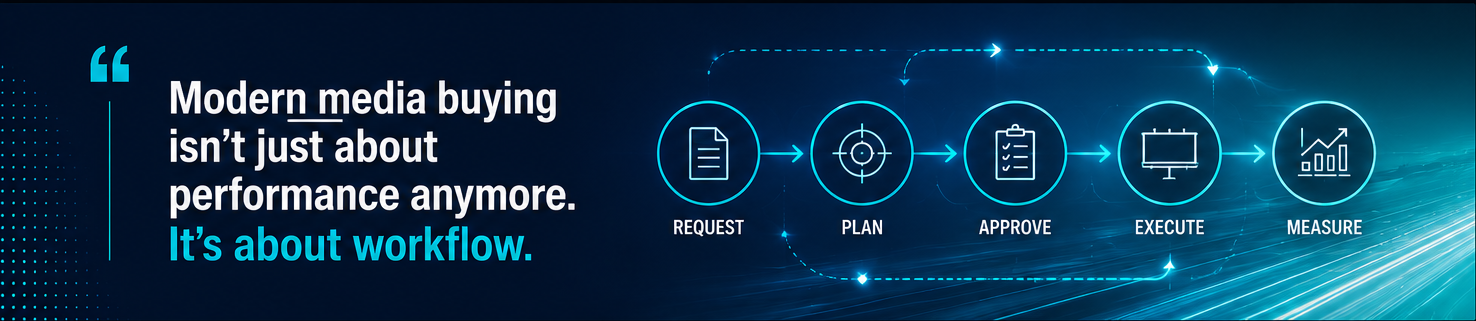
Modern media buying isn’t just about performance anymore.
It’s about workflow.
In other channels, buyers operate inside centralized platforms where they can:
- See inventory instantly
- Evaluate options side by side
- Understand pricing structures
- And act quickly
There’s still strategy. There’s still negotiation.
But the path from idea → evaluation → execution is much shorter.
And that changes behavior.
Because when teams are under pressure to move quickly, they tend to prioritize the options that are easiest to execute.
Where OOH Still Struggles
OOH has always had strengths: visibility, impact, geographic reach.
But the buying process hasn’t evolved at the same pace.
In many cases, it still looks like this:
- An RFP is sent
- Availability is pulled manually
- Pricing is built
- Proposals go back and forth
- Timelines stretch
Even when everything goes well, it takes time.
And not every opportunity makes it through that process.
Sometimes the deal moves forward.
Sometimes it stalls.
Sometimes it disappears entirely.
Not because OOH wasn’t a good fit—but because it wasn’t the easiest option.
The Hidden Problem: Friction
That’s the part we don’t talk about enough.
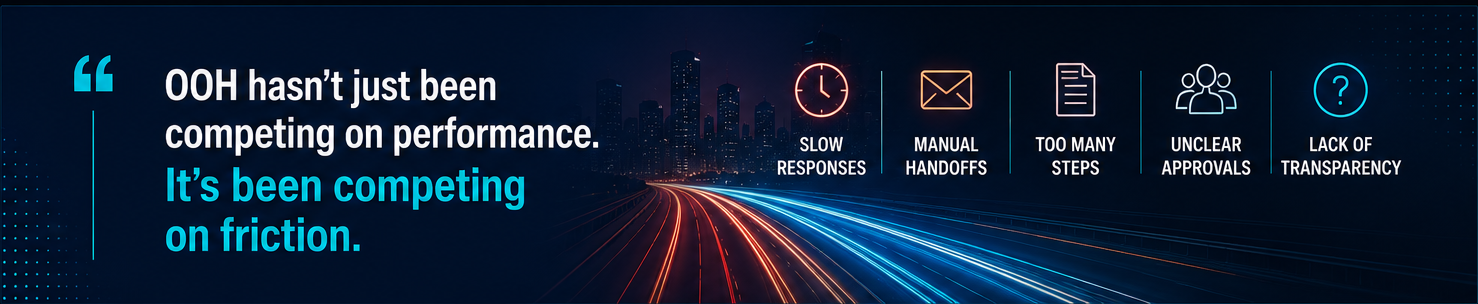
OOH hasn’t just been competing on performance.
It’s been competing on friction.
- How long does it take to respond?
- How easy is it to evaluate inventory?
- How quickly can a buyer move forward?
Those factors don’t show up in attribution models—but they absolutely influence buying decisions.
And in a world where other channels are getting faster and more streamlined, that friction becomes more noticeable.
What Other Channels Got Right
If you look at the channels that have grown share, they didn’t just improve measurement.
They also:
- Standardized how inventory is presented
- Simplified how it’s evaluated
- Reduced friction in how it’s purchased
In short, they made it easier to say yes.
That doesn’t mean those channels are always better.
But it does mean they fit more naturally into how media is bought today.

What This Means for OOH Operators
For operators, this shift is worth paying attention to.
Because it changes the question from:
“How do we prove our inventory works?”
to:
“How easy is it for a buyer to actually buy it?”
Those are two different challenges.
Measurement helps validate value.
But workflow determines whether that value turns into revenue.
As agencies continue to centralize planning and adopt more automated tools, the expectation will be the same:
- Faster evaluation
- Clearer pricing
- Less back-and-forth
- More direct paths to execution
Inventory that fits into that model will move up the list.
Inventory that doesn’t may simply be harder to access.
Where the Industry Is Heading
This shift isn’t theoretical.
Large operators are already investing in ways to streamline how their inventory is bought.
Agencies are increasingly relying on platforms—and in some cases, AI-driven workflows—to plan and execute campaigns.
The direction is clear:
The buying process is becoming more automated, more connected, and more immediate.
And that will influence how budgets get allocated.
Expanding the Conversation
None of this means measurement doesn’t matter.
It does.
But if the goal is to grow OOH’s share of spend again, measurement alone won’t get us there.
We also have to think about:
- How inventory is surfaced
- How pricing is evaluated
- How quickly deals can move forward
Because in today’s media landscape, the channels that win aren’t just the ones that perform.
They’re the ones that are easiest to buy.