
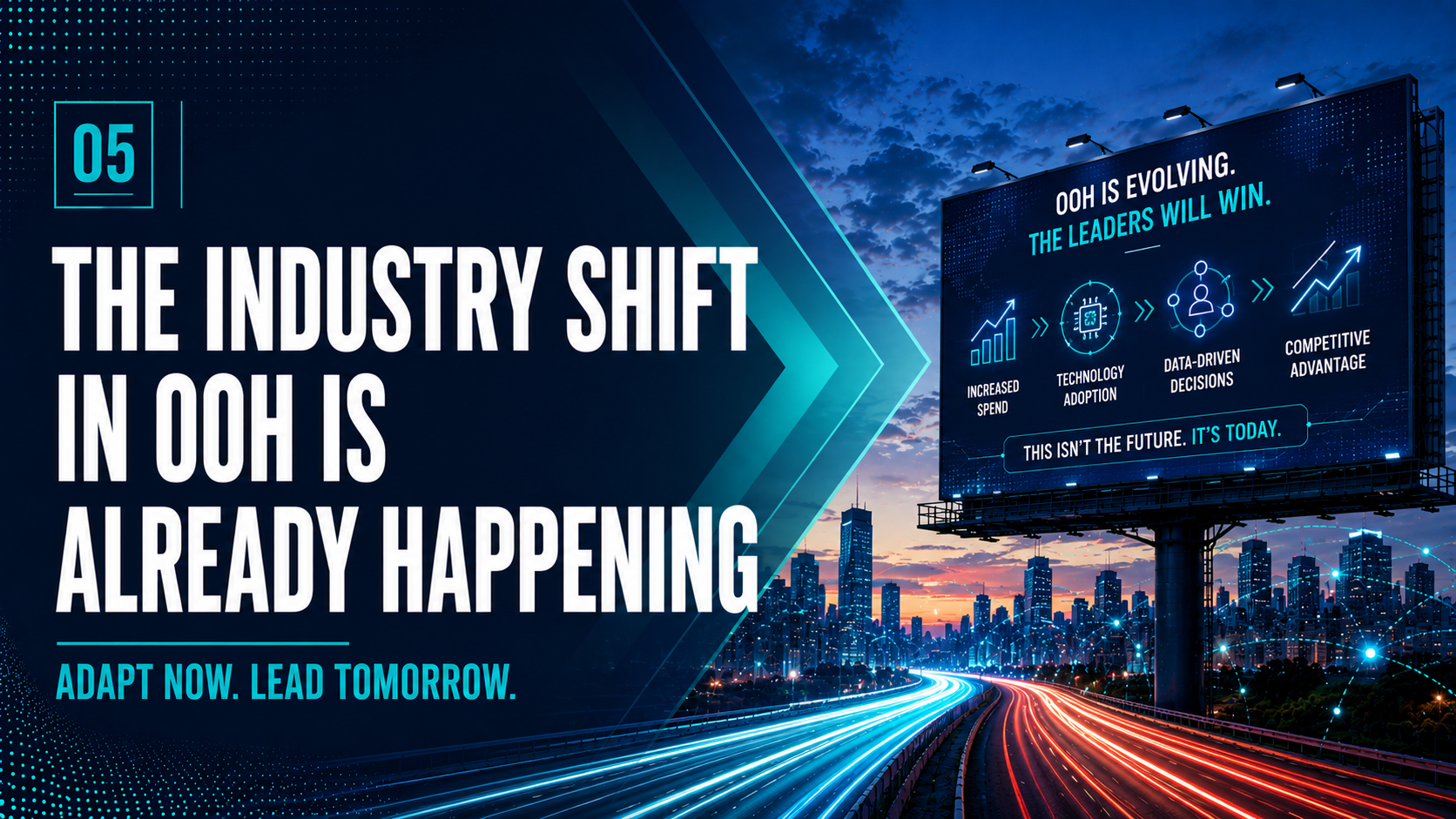
A lot of people in OOH still talk about automated buying like it’s a future conversation.
Something coming someday.
Something the industry will deal with later.
It isn’t.
It’s already happening.
Agencies are changing how they plan.
Large operators are changing how they sell.
Buyer expectations are changing right now.
The shift is already underway.
The only real question is who gets included.
Because this isn’t about chasing trends.
It’s about staying inside the buying process.
OOH Has Been Solving the Wrong Problem
For years, much of the industry conversation has focused on measurement.
Better attribution.
Better proof of performance.
Better ways to defend OOH in the media mix.
That work matters.
Measurement helps justify spend.
But it doesn’t solve the entire problem.
Because buyers don’t just need proof that OOH works.
They need OOH to fit into how modern media actually gets bought.
That means workflow matters just as much as performance.
Sometimes more.
Because even when OOH is the right strategic choice, friction can still push the buy somewhere else.

The Buying Process Has Changed Across Every Channel
Look at how other media channels operate today.
Digital.
CTV.
Social.
They have moved toward:
- centralized planning tools
- faster evaluation of inventory
- cleaner pricing structures
- fewer manual steps
- automated paths to execution
This didn’t happen because buyers became lazy.
It happened because scale demands it.
Modern buying teams are expected to manage more channels, more campaigns, and more complexity—with fewer people and less time.
That changes behavior.
Buyers naturally prioritize the options that are easiest to evaluate and easiest to execute.
That becomes a competitive advantage.
OOH Still Relies on Friction
Now compare that to how many national OOH buys still happen.
Too often, the process still looks like this:
- an RFP is sent
- avails are pulled manually
- pricing is built
- proposals go back and forth
- holds are managed slowly
- disconnected systems create more follow-up
Even when everything works, it takes time.
And not every opportunity survives that process.
Sometimes the deal is lost not because OOH was a bad fit—but because it was the hardest option to execute.
That is not a measurement problem.
That is a workflow problem.
And friction is expensive.
Aggregation Is Not Automation
This is where the industry often gets confused.
A lot of people hear “automation” and assume the answer is simple:
“We just need all inventory in one place.”
That’s aggregation.
Aggregation helps discovery.
It allows buyers to see more inventory more easily.
That’s useful.
But it does not solve decision-making.
It does not solve pricing.
It does not solve approvals.
It does not solve execution.
Automation is something much deeper.
Automation means:
- real-time availability
- pricing logic based on actual business rules
- yield-based qualification
- contract workflows
- rules-based approvals
- fewer manual steps between interest and execution
Aggregation shows inventory.
Automation helps complete the deal.
That distinction matters.
Because one improves visibility.
The other changes how revenue happens.
Large Operators Are Already Moving
The biggest operators in OOH understand this.
They are already investing in automated buying infrastructure.
Not because automation sounds innovative.
Because they understand where agencies are going.
Agencies increasingly reward:
- speed
- simplicity
- direct workflow compatibility
They want fewer steps between planning and placement.
The large operators are helping shape those expectations.
That creates a strategic challenge for independents.
You do not need to match their scale.
But you do need to compete inside the same buying behavior.
Because buyers will not separate their expectations by operator size.
They will simply buy where the process works best.
This Is Not About Becoming Programmatic
This is where many operators understandably get nervous.
Automation gets confused with programmatic.
But they are not the same thing.
Automated buying does not have to mean:
- blind bidding
- race-to-the-bottom pricing
- losing control
- becoming an SSP marketplace
It can mean:
- making inventory easier to evaluate
- protecting pricing with yield rules
- participating inside agency workflows
- speeding up the right deals
That is a very different model.
The goal is not commoditization.
The goal is controlled participation.
That distinction is critical.
The Cost of Waiting
The biggest risk here is not automation.
It is invisibility.
As buyers adopt more connected workflows, inventory outside those systems gets seen later—or sometimes not at all.
Over time, that means:
the pipeline gets smaller
opportunities become narrower
independent operators lose strategic position
This is not dramatic.
It is simply operational reality.
And it happens gradually enough that many operators do not notice it until it becomes difficult to reverse.
That is why waiting is risky.
Not because automation is trendy.
Because buying behavior is changing.
What Smart Participation Looks Like
The right question is not:
“Should we automate?”
It is:
“How do we participate without giving up pricing control?”
How do we stay visible without becoming commoditized?
How do we make inventory easier to buy without surrendering ownership?
That is the real strategic conversation.
Operators do not need less control.
They need better infrastructure.
They need automation that protects pricing, preserves visibility, and fits how OOH actually sells.
The Future Belongs to the Easiest Inventory to Buy
OOH does not lose share because it lacks value.
It loses share when it creates too much friction.
The future belongs to inventory that is:
easy to find
easy to evaluate
easy to transact
—and still protected by operator control.
That is why OOH is moving toward automated buying.
Not because it is fashionable.
Because it is necessary.
And the operators who understand that earliest will be the ones best positioned to benefit from it.